
How a Multi-Currency Privacy Wallet Really Protects You: A case study of Cake Wallet for Monero, Bitcoin and Litecoin

Surprising fact: most mobile wallet privacy features protect either keys or network metadata — rarely both. Yet for privacy-conscious users in the U.S. who move value across Monero, Bitcoin, and Litecoin, the operational privacy picture depends on layers: device security, key custody, transaction construction, and network routing. Examining a mature, open-source, non-custodial wallet that supports XMR, BTC, and LTC lets us see how those layers combine, where the gaps remain, and which trade-offs matter when you choose a daily driver wallet.
This article uses Cake Wallet as a running case to explain mechanisms, compare trade-offs, and surface decision-useful heuristics. I emphasize how device-level protections, protocol-native privacy features, and network anonymity interact — and I flag concrete limits such as migration friction and cross-chain leakage that often surprise users who assume ‘privacy’ is a single switch.
Layered privacy: keys, transaction construction, network anonymity
Think of wallet privacy as three stacked mechanisms. First, key custody: does the user control the private keys and are those keys protected by hardware on the phone? Cake Wallet is open-source and non-custodial — keys never leave the device — and it encrypts wallet data with device-level security (Secure Enclave on iOS, TPM on Android). Access is gated by a 4–6 digit PIN or biometric unlock. That combination reduces the risk that a remote server or the vendor can leak your keys, but it does not remove physical-device risk: if an adversary extracts the device and bypasses hardware protections, seed phrase backups and good operational hygiene remain critical.
Second, how transactions are built. For Bitcoin, privacy is shaped by UTXO management and collaborative protocols. The wallet supports PayJoin v2, Silent Payments, UTXO coin control, and transaction batching. Those tools reduce linkability of inputs and outputs, but they work best when the user actively uses coin control and prefers collaborative transactions. For Litecoin, Cake Wallet supports MWEB (MimbleWimble Extension Blocks), an optional privacy layer; activating MWEB changes how change outputs and aggregation behave, yielding stronger confidential-amount and cut-through-style privacy, but it also creates compatibility and liquidity trade-offs with services that do not support MWEB. For Monero, privacy is protocol-native: subaddresses, ring signatures, and confidential transaction primitives mean transaction graphs are intrinsically obfuscated. Cake Wallet preserves Monero’s private view key on-device and supports background sync to keep the wallet responsive without leaking view keys to external servers.
Network-layer anonymity: Tor, I2P, and custom nodes
Keys and transaction construction matter less if network-level metadata ties an address to an IP. Cake Wallet offers Tor-only mode, I2P proxy support, and the option to connect to user-selected nodes. That’s a major practical advantage: Tor or I2P removes simple IP-to-transaction correlations that occur when a wallet broadcasts transactions directly to the P2P network. But there are important caveats. Tor can be interrupted by carrier-level interference, app-level bugs, or misconfiguration; I2P has different latency and peer-list dynamics; and running your own node improves privacy but increases resource and configuration costs.
Put another way: use Tor/I2P when you need an anonymity boost, and expect UX friction. If you run a custom full node for Monero or Bitcoin, you reduce trust and telemetry exposure, but you must maintain uptime and protect RPC endpoints. The wallet’s zero-telemetry policy is meaningful — it means the developers do not collect IPs or histories — but it does not automatically shield you from deanonymization if you broadcast transactions over clearnet or reuse addresses.
Where core protocol privacy and wallet features intersect (and collide)
Monero and Bitcoin represent two privacy philosophies. Monero builds privacy inside the protocol: ring signatures, stealth addresses and mandatory obfuscation create a baseline privacy guarantee for typical transfers. Bitcoin relies on tooling and collaborative techniques layered on an entirely transparent ledger. Cake Wallet’s approach is pragmatic: it preserves Monero’s in-protocol guarantees (keeping the private view key on-device and using subaddresses) while offering advanced Bitcoin privacy tooling (PayJoin v2, Silent Payments, UTXO control) to compensate for on-chain transparency.
Litecoin’s MWEB is an optional privacy extension. When activated, MWEB provides confidential amounts and aggregation benefits that approximate some of the privacy improvements seen in MimbleWimble designs. But optionality introduces friction: wallets, exchanges, and services must adopt or support MWEB to avoid interoperability problems. That’s a common trade-off in privacy engineering — choosing a stronger privacy posture sometimes narrows your counterparties.
Hardware integration and air-gapped security: Cupcake and Ledger
Hardware wallets reduce attack surface by isolating signing keys. Cake Wallet integrates with Ledger devices and an air-gapped solution called Cupcake. In practice this integration moves the private-key signing step off the general-purpose device and into purpose-built hardware, which is highly protective against software exploits and remote compromise. The trade-off is convenience: frequent on-chain activity (small value, many transactions) becomes slower and slightly more cumbersome when every signature requires a hardware confirmation. For privacy-minded users, that trade-off often favors hardware integration for large-value transfers and operational wallets for routine spending.
Built-in swapping and cross-chain privacy risks
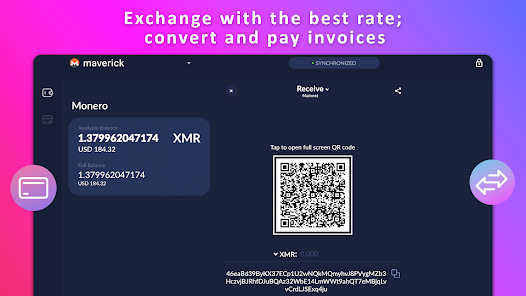
Cake Wallet supports instant swaps across many assets via built-in exchange routes and uses NEAR Intents to route across liquidity providers. That decentralized routing reduces reliance on a single exchange, which is positive for custody and leakage. However, cross-chain swaps introduce their own privacy risks: counterparties, on-ramp/off-ramp integrations, and timing correlations can create linkages between incoming and outgoing assets. The wallet’s no-telemetry stance reduces developer-side leak risk, but users should treat swaps as operations that may require privacy hygiene — splitting amounts, using private in-protocol rails (like XMR or MWEB), or routing through decentralized markets — depending on threat model.
Operational limitations and migration friction you should know
No single wallet eliminates all privacy risks. There are concrete limitations to keep visible. One practical limitation: Zcash migration from Zashi wallets to Cake’s implementation is not seamless because of differences in change-address handling — seed compatibility can fail, forcing manual transfers. This is emblematic: protocol differences, optional extensions (MWEB), and legacy wallets create migration friction that can disrupt privacy or cost time and fees. Another limitation is device compromise: Secure Enclave and TPM materially raise the bar, but they are not foolproof against sophisticated physical attacks or exploitable firmware.
Equally important is user behavior: address reuse, poor backup practices, or broadcasting transactions over clearnet will undo many wallet-level protections. Privacy is compositional — the weakest layer tends to determine the overall outcome.
Decision framework: choosing features by threat model
Here’s a practical heuristic for U.S.-based privacy-oriented users selecting a wallet setup:
– If your primary adversary is broad surveillance (ISP-level, casual onlookers): enable Tor-only mode, avoid address reuse, and prefer Monero for sensitive transfers; use MWEB for Litecoin when counterparties support it.
– If you worry about targeted forensic analysis (chain analysis companies, subpoenas tied to exchanges): combine Monero for the most sensitive flows, use Ledger/Cupcake hardware for high-value custody, and use PayJoin v2 and Silent Payments for BTC to disrupt conventional UTXO heuristics.
– If you need operational convenience while maintaining reasonable privacy: run the wallet on a device with Secure Enclave/TPM, use background sync for Monero, and rely on the wallet’s coin control features for Bitcoin, while treating swaps as potentially linkable unless you split and stagger transactions.
Where to watch next
Three signals matter for near-term evolution. First, adoption of protocol-side privacy features (e.g., wider MWEB support across exchanges) will reduce interoperability friction and increase practical privacy for Litecoin users. Second, collaborative Bitcoin standards like PayJoin and any future advances in CoinJoin UX will determine how usable BTC privacy becomes for mainstream users. Third, improvements in mobile OS-level security and attestation will change the trade-off between convenience and hardware-backed custody. Watch for wider node-support integrations and any changes in regulatory signals that force on-ramps to demand more KYC; those will change practical privacy more than technical upgrades alone.
For a user-oriented overview and to explore specific multi-currency workflows, it is useful to consult a wallet that documents these features transparently and lets you control the variables yourself: cake wallet.
FAQ
Q: If my phone is stolen, are my private keys safe?
A: Device-level encryption (Secure Enclave on iOS, TPM on Android) plus a PIN or biometrics substantially reduce remote compromise risk and make cold-extraction harder. However, if an attacker obtains the seed phrase or can perform advanced hardware attacks, they can recover funds. Treat seed phrases as the single-point failure and store them offline and redundantly.
Q: Is Monero always more private than Bitcoin in practice?
A: Protocol-specified, Monero provides stronger default privacy through ring signatures and stealth addresses. Bitcoin can approach meaningful privacy with tools like PayJoin v2 and coin control, but achieving parity requires disciplined use and cooperative counterparties. In practice, Monero reduces user burden for privacy, whereas Bitcoin demands active management.
Q: Will enabling Tor/I2P slow down my wallet?
A: Yes — Tor and I2P add latency and may occasionally disrupt connectivity. For many users, the privacy benefit is worth the slower sync times, but if you need low-latency payments, run a trusted node or accept the trade-off.
Q: Are built-in swaps private?
A: Built-in, decentralized routing via NEAR Intents minimizes central custodian risk, but swap counterparties and timing correlations can leak information. Treat swaps as operational events that may need additional privacy steps if your adversary conducts chain analysis.